Showing posts with label Islam. Show all posts

Monday, 27 May 2019

The Mosque that Was: Siraj-ud-Daula's Alinagar Masjid


With a population of a million Muslims, Calcutta or Kolkata has well over 500 mosques. While most of these mosques are from the 19th century, there are a few which are older. But what could have been one of the grandest and most historic mosques of the city, does not exist anymore. The mosque, established by the Nawab of Bengal, Siraj-ud-Daula, would have existed in Dalhousie Square, the city’s central business district, and would have been a marker of the biggest armed conflict in the history of the city – the 1756 Siege of Calcutta.

Alinagar Masjid as imagined by Rounak Patra


Monday, 10 December 2018

Akbar's Tomb, Sikandra


“Jalaluddin Mohammed Akbar, guardian of mankind” – I learnt the Kipling poem when I was in school, and its opening lines were all I could think of as we drove the 5 miles from Agra to the Emperor’s final resting place, Sikandra. Growing up in India, the history you are taught in school is somewhat one sided, but creates a lasting impression, especially about the Mughal Emperors of India. Babur was the conqueror. Jahangir was the just one. Shah Jahan was the romantic. Aurangzeb was the angry old man. But only Akbar was “The Great”. A king who was just, fair, a great warrior, a wise administrator, a man who gathered around him a court of such brilliance that stories about it are told to this day. Every child in India knows the stories of Akbar and his court wit, Birbal, about his Hindu Rajput wife, Jodha Bai, who in all fairness is more legend than fact, and about how his court musician, the Vaishnava Tansen, could make it rain by singing the raga “Malhar”. Akbar is to Indian history what Shahrukh Khan is to Bollywood cinema – a superstar you see on screen or read about, but never imagine will be able to approach. Needless to say, I was excited as I stepped into the vast funerary garden at Sikandra – this is the closest any human being could get, to Akbar the Great.

Akbar's Mausoleum, Sikandra


Thursday, 20 September 2018

The Imambaras of Kolkata


Say the word Imambara to the average Bengali in Kolkata, and what he or she is likely to think of first, is the Hooghly Imambara. Prod a little further and the Nizamat Imambara will come up. Located in Murshidabad, it is the largest in Asia. The really well-informed will be able to name the Sibtainabad Imambara in Metiabruz where Wajid Ali Shah, the last Nawab of Oudh is buried. But what the vast majority of people in Kolkata don’t know is that there are some 20 imambaras in city, most with long histories and some are spectacularly beautiful. For Muharram this year I would like to highlight this unknown aspect of Kolkata.


Friday, 15 June 2018

The Abandoned Mosque of Beliaghata

On Beliaghata Main Road, a little under a kilometre southeast of the point where the road crosses the canal lies a mysterious, abandoned mosque. I say abandoned because the mosque is not used for prayers by Muslims anymore, although it is far from empty. What was once a mosque is now used as a residential building and storage space. I first found out about the abandoned mosque in Beliaghata from a Facebook post by my friend Avijit Das. Avijit and Souvik had been alerted to the presence of the mosque by another Facebook post. “Sayan Banerjee had posted about the mosque, claiming that it was the oldest mosque in Kolkata and that it was ASI property”, Souvik told me. But when they visited the site, they found it to be occupied by a Hindu family. Souvik was able to identify the family as Vaishnava based on the “kanthi” or wooden necklace that a male member of the family was wearing. The sheer ridiculousness of a Vaishnava family living inside a mosque was enough to pique my curiosity, and so I decided to do some investigation of my own.

The western side of the mosque

Sunday, 6 May 2018

Sayed Jamaluddin's Mosque, Saptagram

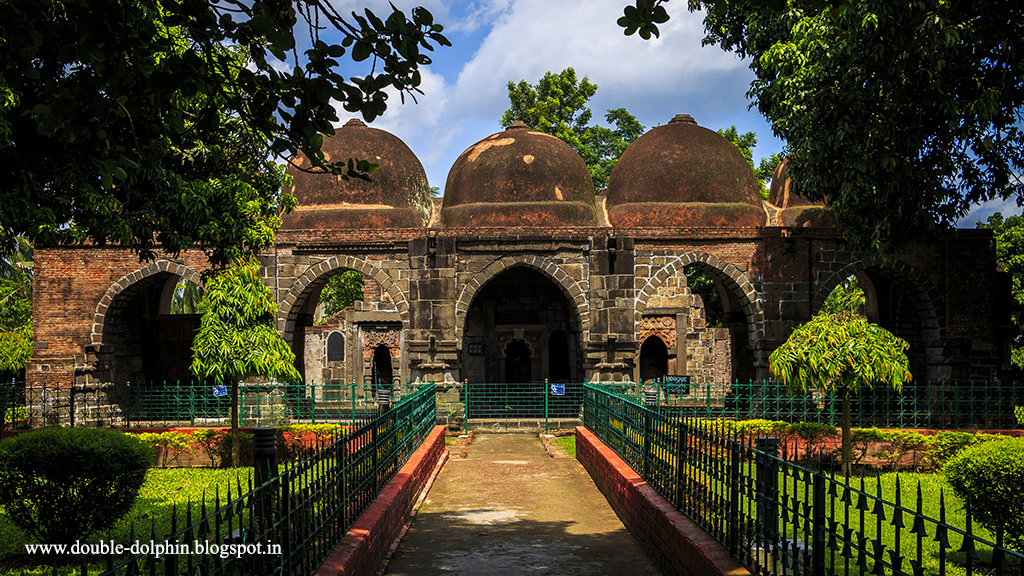
Located in the Saptagram area of Hooghly district in West Bengal, Sayed Jamaluddin’s Mosque is the only surviving monument from the Hussain Shahi period when Saptagram was a flourishing port and mint town. The last surviving witness of the glory days of this erstwhile capital of southern Bengal, Sayed Jamaluddin’s mosque is also a fine example of that phenomenon unique to Bengal – a terracotta mosque.


Tuesday, 3 October 2017

Blood of the Faithful: An Outsider's Experience of Muharram in Calcutta

Every year as Muharram approaches, Calcutta (Kolkata) radio veteran Mir Afsar Ali must remind his non-Muslim listeners not to wish their Muslim friends a “happy Muharram” because it is not a happy occasion. For most non-Muslims in India, Islamic rituals and practices in general, and Muharram, in particular, remains a complete mystery. People’s reaction to Muharram commemorations is tinged with fear. So this year, I set out to experience and document Muharram commemorations in my hometown, Calcutta (Kolkata).

The gathering at Gol Kothi, listening to the story of Karbala

WARNING: THIS ARTICLE CONTAINS EXTREMELY GRAPHIC IMAGES. DISCRETION IS ADVISED. DO NOT PROCEED BEYOND THIS POINT IF THE SIGHT OF BLOOD DISTURBS YOU.

Saturday, 19 August 2017

No, Suhrawardy Avenue is not named after "The Butcher of Bengal"

Jaideep Mazumdar’s article in Swarajyamag on August 16th carried the sensational heading – 'It’s A Crying Shame That ‘The Butcher Of Bengal" Has A Road Named After Him In Kolkata”. Swarajya has been publishing one-sided, inflammatory articles for some time now, but in this case, the article is factually incorrect, because Suhrawardy Avenue is NOT named after Huseyn Shaheed Suhrawardy, the last Prime Minister of Bengal, but after Sir Hassan Suhrawardy, the first Muslim Vice-Chancellor of Calcutta University.

Sunday, 19 March 2017

Garden Reach: The Forgotten Kingdom of Nawab Wajid Ali Shah

My research into Wajid Ali Shah, the last Nawab of the Kingdom of Oudh (Awadh) started as a simple question – where was he buried? I knew that he had come to Calcutta once the East India Company had dethroned him. But if he had come to Calcutta, would he have died in Calcutta and if he had died in Calcutta, wouldn’t he have been buried in Calcutta? Google threw up a name – Sibtainabad Imambara. But where was this? Further curiosity would lead me to this post on the Astounding Bengal blog. There were scattered newspaper articles on the Nawab as well, but there seemed to be no one place where I could get the complete information. That is when I knew that I would have to do this myself, and as a friend and collaborator, I found Shaikh Sohail, who has the twin advantages of being a resident of the area where the Nawab once stayed and being on good terms with his descendants. More than 100 years after he died, are there any vestiges of Nawab Wajid Ali Shah that still remain?


Monday, 27 June 2016

Zafar Khan Ghazi Masjid: Bengal's Oldest Mosque

Located some 70 km to the North of Calcutta (Kolkata), in the town of Tribeni, the Zafar Khan Ghazi Masjid is not just the oldest mosque of Bengal, it is the oldest standing Islamic structure of any kind. The complex consists of a mosque and a dargah, with several tombs and it remains an active religious site. However, the identity of the man, i.e., Zafar Khan Ghazi, remains something of a mystery and colourful tales about him continue to circulate. So just who was this man and why does the mosque that he built, look so strange?

The Zafar Khan Ghazi Masjid


Monday, 20 June 2016

Pariyon Ka Talab, Aurangabad

From the fort of Daulatabad National Highway 211, aka the Solapur-Dhule Road, takes you North West, towards the town of Khuldabad. Around 10 km down the road, a dirt track leads off the highway towards a place called Sulibhanjan. Here, next to a small hill, is Pariyon Ka Talab, the Lake of the Fairies. A minor tourist attraction, Pariyon Ka Talab is associated with a Muslim saint who could grant fertility and is an active religious site even today.

Pariyon Ka Talab: view from Shah Jalal-ud-din's Dargah

Monday, 13 June 2016

Pandua (Malda): Ruins of a Former Capital

Located in the Malda district, in the North of the Indian state of West Bengal, Pandua is also known as Hazrat Pandua or Boro-Pendo (larger Pendo). The prefix “Hazrat” is thanks to several prominent Muslim saints and preachers who made the city their home. Chief among them are Jalaluddin Tabrizi and Nur Qutb Alam, whose tombs have made Pandua a Muslim pilgrimage site. Boro-Pendo is to distinguish Malda’s Pandua from the town in the Hooghly district which bears the same name and is consequently called Chhoto-Pendo, meaning smaller or lesser Pandua. From the mid-fourteenth to the mid-fifteenth century, Pandua served as the capital of Bengal under the Ilyas Shahi Dynasty and would continue to serve as a mint town until the time of Sher Shah, aka Sher Shah Suri. Pandua today, apart from being a centre of pilgrimage, is a tourist attraction thanks to the many ruins from Bengal’s Sultanate period.

Adina Masjid - view from the East

Tuesday, 31 May 2016

The Ruins of Gauda: Bengal's Ancient Capital

Gauda (also spelt Gaur or Gour), located in the Malda district in the North of the Indian state of West Bengal, is a ruined city that served as the capital of Bengal between the 12th and 16th centuries. Over a period of four centuries, Gauda has seen more than a dozen ruling dynasties come and go and today is home to some spectacular ruins mostly from Bengal’s Islamic period. Historically and architecturally there is much in Gauda that is of interest, especially its spectacular mosques.

Inside Gunamanta Masjid, Gauda

Monday, 9 May 2016

Lake Mosque, Rabindra Sarobar

The Lake Mosque is the only example of a mosque in the middle of a lake in the city of Calcutta (Kolkata). It is also one of the city’s many little secrets, because, in spite of the fact that it is right there, staring everyone in the face, many people are not aware of its existence. But how did a mosque come to be located in the middle of the Dhakuria Lake or Rabindra Sarobar, as it is now called? Who built it, and when? Let us begin with the story of the lake itself.


Monday, 2 May 2016

Jama Masjid, Lucknow

When I told my family that I wanted to visit Lucknow’s Jama Masjid, everyone was surprised. “There’s a Jama Masjid in Lucknow? We thought that was in Delhi”! Many non-Muslims would probably react in the same way because few know that the name “Jama Masjid” does not refer to a specific mosque, but rather to a particular kind of mosque. Before I tell you about Lucknow’s Jama Masjid, perhaps I should explain what a Jama Masjid is.


Monday, 25 April 2016

Tomb of Malik Ambar, Khuldabad

On the 14th of May 1626, at the grand old age of 80, Malik Ambar, the man who turned the little village of Khadki into the city we now know as Aurangabad, halted Mughal ambitions in the Deccan with an entirely new kind of warfare, and almost single-handedly saved the Nizam Shahi Dynasty of Ahmadnagar from obliteration, breathed his last. An eyewitness of Deccan affairs over many years, the author Bhim Sen wrote in his Nushka-i-Dilkusha, “although Malik Ambar was dead, but his sweet fragrance still remained behind”. He was a man so remarkable that even Mu'tamad Khan, Mughal Emperor Jehangir’s biographer, who had no love for him, was forced to acknowledge, “in warfare, in command, in sound judgement, and in administration, he had no equal or rival”. But perhaps the most remarkable thing about Malik Ambar was the fact that this Indian king, was in fact, not Indian, but African.


Monday, 18 April 2016

Mughal Gardens of Khuldabad

The little town of Khuldabad in the Indian state of Maharashtra was known as Roza or Rauza meaning garden of paradise thanks to the large number of Dargahs or tombs of Muslim saints that it is home to. But apart from the saints, there are also two other interesting tombs. One is of a royal while another is of a warrior. One is well known while the other is obscure. But around both, a Mughal Garden was originally laid out. Armed with Pushkar Sohoni’s book on Aurangabad and Khuldabad, I set out in November of 2015 to find these gardens. But before I tell you the story of my quest, let me tell you about what a Mughal Garden is.

Jahan Banu Begum Bagh

Monday, 11 April 2016

Aurangzeb's Tomb, Khuldabad

Mughal Emperor Aurangzeb’s tomb in the little town of Khuldabad, near Aurangabad in the Indian state of Maharashtra, is the first Mughal tomb I ever visited, and it is starkly different from any other Mughal tomb. No grand Taj Mahal like structures here. The Emperor was a pious man of austere habits and hated ostentation. His simple tomb, open to the sky, is a lesson in humility. But how did that the richest, most powerful man in the world come to be buried in an open, unmarked grave?

Aurangzeb's Tomb - note marble "jaali" screen placed by Nizam of Hyderabad

Monday, 15 February 2016

Alamgir Masjid: Aurangzeb's Personal Mosque, Aurangabad

The Alamgir Masjid of Aurangabad in the Indian state of Maharashtra, also known as the Shahi Masjid (Royal Mosque), is the personal mosque of Mughal Emperor Aurangzeb. Surprisingly not many people seem to be aware of this, even though this is one of the most important Mughal era monuments of the city. My friends in a popular Aurangabad radio station didn’t know about and neither did my chauffeur Anand who had lived in the city all his life. The only reason I found the mosque was because I was looking for it, because I had read about it in Pushkar Sohoni’s book.


Monday, 8 February 2016

Hooghly Imambara

Around 60 km to the North of Calcutta (Kolkata), in the Hooghly-Chinsura municipality may be found the magnificent Hooghly Imambara. An Imambara, also referred to as a Hussainia, an Ashurkhana or Imambargah, is a congregation hall for Shia commemoration ceremonies, especially those associated with the remembrance of Muharram. The Hooghly Imambara functions as both a Mosque and an Imambara. With its striking 80 feet tall towers above the main gate, it is the principal tourist attraction of the area. Although the Hooghly Imambara is associated with Haji Md. Mohsin, the original Imambara existed long before he had the present one constructed.


Monday, 21 December 2015

Basri Shah Masjid: Calcutta's Oldest Mosque (err...maybe!)

The oldest mosque in Calcutta (Kolkata) should be called the Basri Shah Masjid, but unfortunately, the name has been anglicized to Bhosri Shah, Bhonsri Shah, or even Bhousri Shah by some chroniclers of the city, such as the venerable Cotton. It is unfortunate because in Hindi, Bhosri literally means c*nt, and is used in the same sense; as an obscenity. But that is not the only thing that is intriguing about this mosque. Its claim to being the oldest mosque of Calcutta also cannot be unambiguously verified; a definite date of construction cannot be found. Neither can I confirm to you its exact address. The municipality’s list of heritage buildings says that this is a Grade I heritage building, and is “popularly known as 1 Lock Gate Road”. Pijush Kanti Roy’s Mosques in Calcutta says that the address is 8 Seth Pukur Road. Ok, so age not verifiable; exact address not confirmable, does it even exist? Oh yes it does! Here it is in Google Maps. See those three green (actually almost fluorescent yellow) domes? That is it. But when it comes to Basri Shah, we are dealing with two structures, not one. Thoroughly confused? Good. Now we can begin.